Tag: fgc
-

Supercycle simulation
Why simulate a supercycle See FGC yellow pages: https://accwww.cern.ch/proj-fgc/gendoc/def/PropertyFGC.htm#FGC.CYC.SIM Use this functionality if you wish to test a converter with your own cycles (equivalent to using "local timing" in the old electronics): Be aware of the dangers Simulating a supercycle should never be made when there is beam in the machine because it bypasses the
-
No-PPM, PPM and Multi-PPM
These behaviours are set by the properties DEVICE.PPM and DEVICE.MULTI_PPM in the FGC3 configuration This behaviour is requested by the CCC, it is also set in the CCDB and does not normally change during the lifetime of a converter. Background The CCC controls when a power converter starts playing a user function by means of
-
unblock synchronisation
In case of "bad state" response when typing S CONFIG.MODE SYNC_DB you can type the following command to reset the synchronisation state: S CONFIG.STATE RESET Then try again S CONFIG.MODE SYNC_DB
-
LIMITS.I.EARTH
This FGC property has no effect as a trip level (which is fixed inside the state machine card). You set this to be the voltage level that trips the converter. The trip level is 0.6V (=0.006A) for SIRIUS and is defined by the rail of the comparator in the state machine card. When you set
-
Highly saturating magnets and pre-functions
The duration of a pre-function is "predicted" by the FGC doing a basic calculation dt= (L*di)/(V+RI) and hence the FGC knows when to start the pre-function in order to arrive on-time for the beam extraction. However, in case when a heavy magnet saturation takes place (typically at high current only), the calculation is not correct
-
Create TABLE function
# Produce a unipolar square waveform # using a table function #first disable the user looking to modify !S REF.FUNC.PLAY(2) DISABLED ! S REF.FUNC.TYPE(2) NONE #Define a trapezoidal table for User 02 ! S REF.TABLE.FUNC.VALUE(02) 0|0,0.40|0,0.5|100,0.6|100,0.7|0,1.2|0 # set the user 02 function to be TABLE ! S REF.FUNC.TYPE(02) TABLE ! S REF.FUNC.PLAY(02) ENABLED # Make
-
Play RAMP function
To play a ramp function on user 2, once every 04 cycles (period 4.8s) load the following configuration file:
-
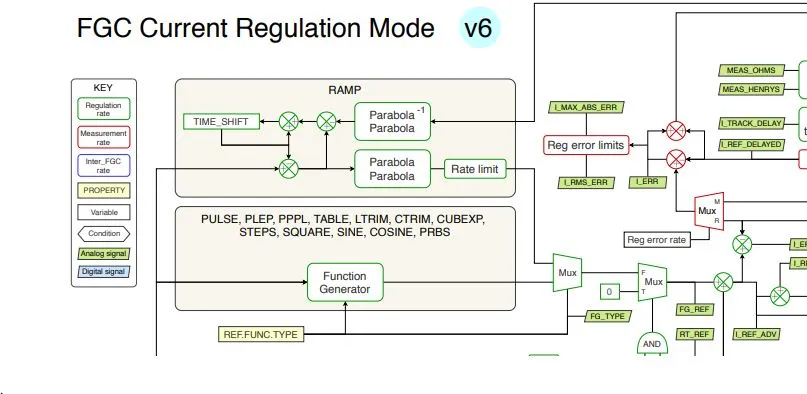
FGC3 block diagram
The FGC3 regulators are described in the FGC Yellow pages http://proj-fgc.web.cern.ch/proj-fgc/gendoc/def/PropertyREG.htm#REG.I Current regulation diagram pdf Voltage regulation diagram pdf
-
REF.CYC.STATUS gives PRE_FUNC_WRN
The pre-function error (in seconds) is given using the G REF.CYC.PRE_FUNC_ERR(#usr). This value returns the difference between a theoretical pre-function time and the actual pre-function the fgc managed to play in the time available. The theoretical value is calculated by adding the calculated times of ramping up, the duration of the MAGCYCLE plateau (REF.DEFAULTS.PLATEAU_DUR[0]), any
-
Current loop properties
This property contains the period for the operational current regulation algorithm. With 10 it means a sampling rate of 1kHz which is normally fine for our application and that Auxpole 1 and 2 could reach a value of 100Hz. This property contains the pure delay in iterations between the calculation of the actuation by the